
Henry and Ann Timpson · Kings Cliffe · 1861-1870
Kings Cliffe
Henry and Ann moved to Kings Cliffe.
Their Children Born at Kings Cliffe
Mary Lizzie Timpson (TW1)
Their first child was born on 7 November 1861 at West Street, Kings Cliffe and registered in civil registration records by her mother on 15 November 1861. Henry’s occupation is given as Grocer.
Mary Lizzie was baptised by the Rev Edward Wells (along with her brother Harry William) on 14 January 1866 at All Saints Church and the parish registers have her baptism recorded as Mary “Elizabeth” “Timson”. Henry’s occupation is given as Gamekeeper.
(In genealogy civil registration names take precedence over parish records and spelling of names when people are literate enough to write them takes precedence over verbally spoken names which can be misinterpreted)
Jenny Finetta Fanny Timpson (TW2)
Their second child was born on 22 September 1863 at West Street, King Cliffe and registered in civil registration records by her mother on 23 October 1863. Henry’s occupation is given as Grocer.
Jenny Finetta Fanny was baptised by the Rev Edward Wells on 8 May 1864 at All Saints Church and the parish registers have her baptism recorded as “Jenney” Finetta Fanny Timpson. Henry’s occupation is given as Shepherd.
Sadly Jenny Finetta Fanny passed away aged 2 years on 10 October 1865 at West Street, Kings Cliffe. Her name was spelled correctly in the civil records. Henry’s occupation was given as Gamekeeper. Her burial service by Rev Edward Wells took place at All Saints Church on 21 October 1865 under the name of “Jenney” Finetta Fanny “Timson”. (The time between her death and burial seems excessive and as the entries in the parish registers are made retrospectively I think the Rector had a guess!).
Harry William Timpson (TW3)
Their third child was born 14 October 1865 at West Street, Kings Cliffe and registered in civil registration records by his mother on 20 November 1865. Henry’s occupation is given as Gamekeeper.
Harry William was baptised by the Rev Edward Wells on 14 January 1866 at All Saints Church and the parish registers have his baptism recorded as Harry William “Timson”. Henry’s occupation is given as Gamekeeper.
Charles Timpson (TW4)
Their fourth child was born on 2 October 1867 at West Street, Kings Cliffe and registered in the civil registration records by his mother on 16 October 1867. Henry’s occupation is given as Gamekeeper.
Charles was baptised by the Rev Edward Wells on 12 April 1868 at All Saints Church and the parish registers have his baptism recorded as Charles Timpson. Henry’s occupation is given as Gamekeeper.
Ada Fanny Timpson (TW5)
Their fifth child was born on 10 September 1869 at West Hay, Kings Cliffe and registered in the civil records by her mother on 9 October 1869. Henry’s occupation is given a Gamekeeper.
Ada Fanny was baptised by the Rev Edward Wells on 10 April 1870 at All Saints Church and the parish registers have her baptism recorded as Ada Fanny Timpson. (The Rev Wells seems to have finally gotten his head around the “p” in Timpson). Henry’s occupation is given as Gamekeeper.
(Henry and Ann never seemed to be in a hurry to have their children baptised for whatever reasons!)
Kings Cliffe Family Life
Henry’s mother Ann Timpson née Eagle had sadly passed away on 3 January 1862 and had been buried at Apethorpe with her much loved husband on 5 January 1862.
We know from the death registration of Jenny that by 10 October 1865 Henry is a Gamekeeper.
Henry The Gamekeeper
The first time we found Henry acting as a Gamekeeper is the following article in the Northampton Mercury dated 19 November 1864.
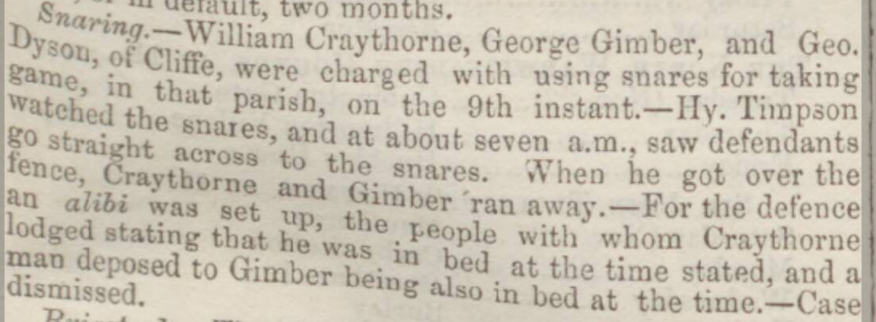
NORTHAMPTON MERCURY · 16 november 1867
An article about poachers caught by Henry Timpson in his role as Game Keeper.
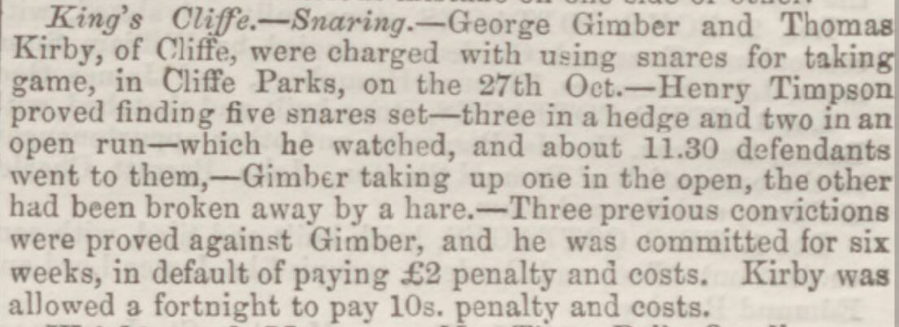
NORTHAMPTON MERCURY · 19 November 1864
Another article about snares and Henry Timpson. Looks like he got George Gimber that time.
So what did Henry do as a Gamekeeper?
Typically, a gamekeeper is employed by a landowner, and often in England by a country estate, to prevent poaching, to rear and release game birds such as common pheasants and French partridge, eradicate pests, and to control predators such as weasels, to manage habitats to suit game, and to monitor the health of the game.
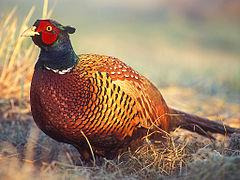
The gamekeeper was one of the most important members of the outdoor staff. More specifically His duties included rearing game birds for shoots, breeding, killing and skinning rabbits, breeding deer, setting traps, destroying vermin, training hunting dogs and keeping watch for poachers.
He was expected to be well-trained in gun use and an excellent shot. April and May were busy times for gamekeepers, as this was when the breeding season for game birds such as pheasants and partridges began. First, the hens had to be caught and taken to laying pens. Once the eggs were laid, broody hens were brought in to act as surrogate mothers.
All the while, the gamekeeper had to keep a vigilant watch for predators such as magpies and jackdaws. When the eggs hatched, the chicks were moved to the rearing field, where numerous wooden bird coops were set up. Tunnels and traps were set up around the edge of the coops to catch vermin such as rats and stoats. When the birds were a few weeks old they were released into nearby cover and watched over by the Gamekeeper.
The shooting season began in autumn and this was another busy time for gamekeepers. At such times, beaters were brought in to beat the undergrowth with sticks, to draw the birds into the open.
Gamekeepers stood by during the shoot, collecting the birds as they were shot and providing cartridges for the shooters. Gamekeepers often received tips from visitors, particularly when they had to return to base to get new cartridges. Indeed, a visitor who was not generous might find that the gamekeeper mysteriously disappeared when new cartridges were needed!
In 1867 we know that Gamekeepers were paid 15 to 20 shillings a week so a definite step up in pay for Henry and his growing family.
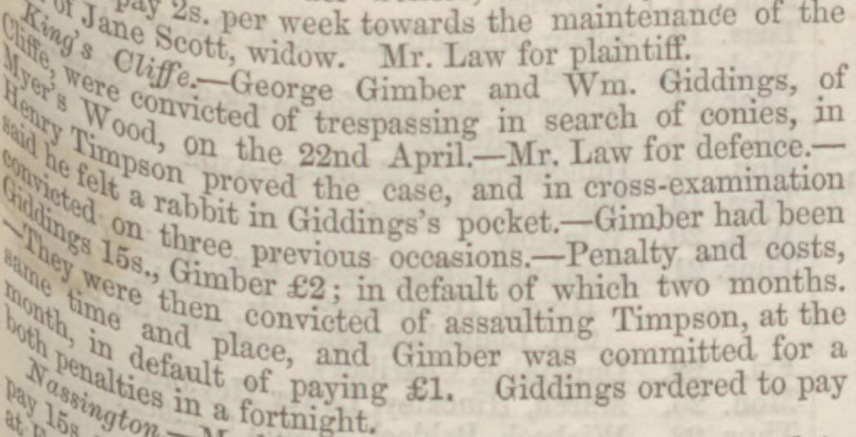
NORTHAMPTON MERCURY · 2 May 1868
The life of a Gamekeeper is not easy. Gimber seems a persistent offender and a person Henry consistently catches.
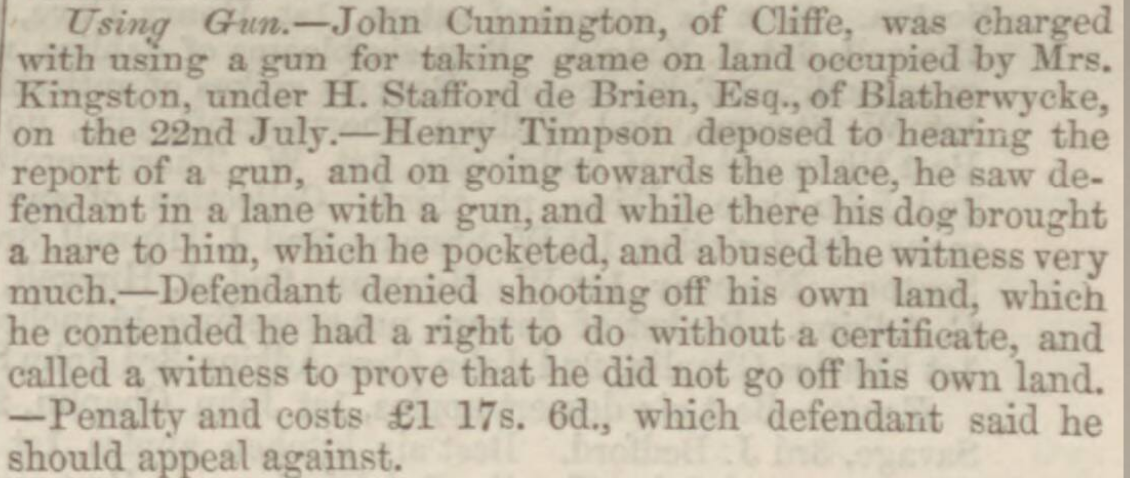
NORTHAMPTON MERCURY · 22 August 1868
The first mention of an employer of Henry Timpson is in this article about man shooting a gun inappropriately.
So at this point in time anyway he is working for a Mrs Kingston.
West Hay Lodge
The family residence when Ada Fanny was born was West Hay Lodge a move from West Street and would have been multiple housing provided free by Henry’s new employer.
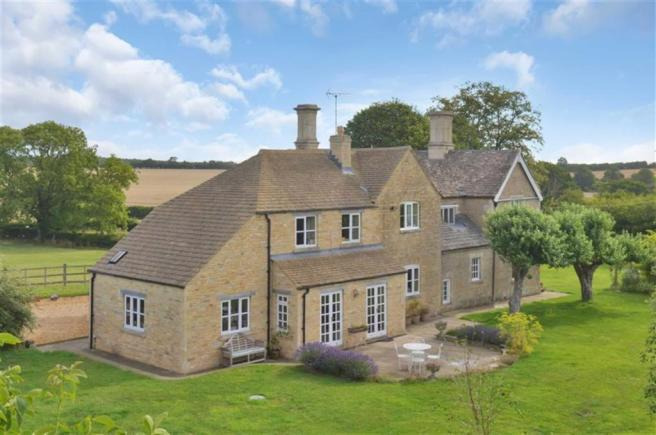
From an article written about the times we are able to deduce that Henry’s employer while he was Gamekeeper living at West Hay Lodge, Kings Cliffe was the Marquis of Exeter and that the Marquis was not popular in Kings Cliffe.
What we now know as the fields appurtenant to West Hay (new) Lodge Farm and to West Hay Farm proper, were woodlands stretching from Law’s Lawn across to the West Hay Wood, as we know it today. Clearance of these woodlands began about 1856 and issued in the establishment of two new arable farms, with the two farmhouses of West Hay Lodge and West Hay farm. The Stamford road ran through their midst; it was strictly “extra-parochial” territory. The Marquis of Exeter owned these new arable fields on each side of the deplorable road from Cliffe to Stamford; shouldn’t he be held responsible for a rate to repair and maintain the road? Many were the public meetings held down in King’s Cliffe to determine the issue and long did battle rage in the 1860’s!
Northampton Mercury
Being a Gamekeeper meant you were not popular amongst certain classes of people as this next article from the Northampton Mercury dated 4 September 1869 shows.
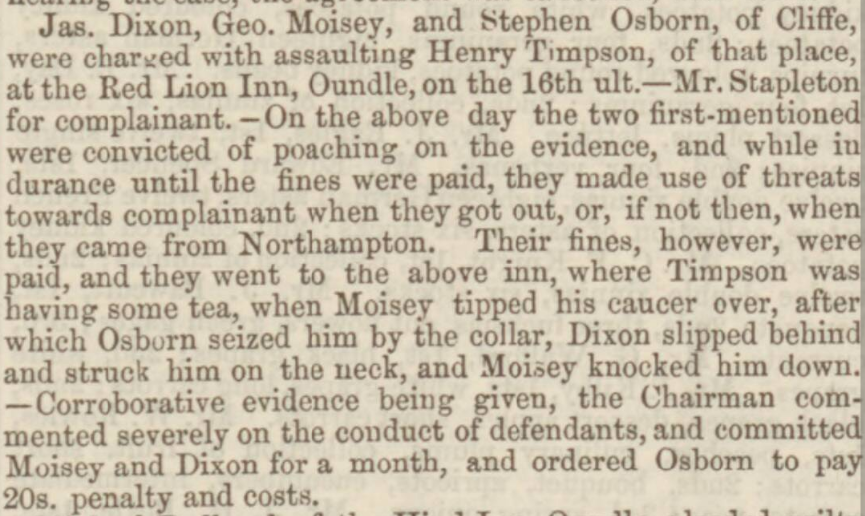
NORTHAMPTON MERCURY · 1869
Henry Timpson, Gamekeeper, catches poachers.
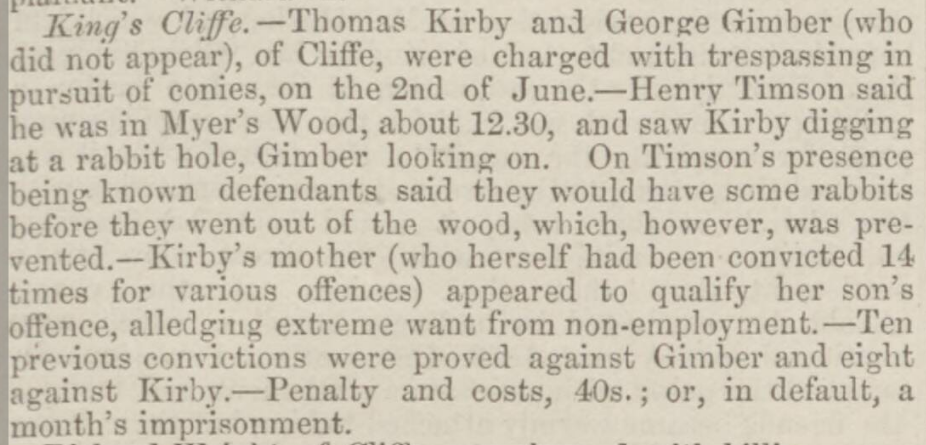
NORTHAMPTON MERCURY · 25 june 1870
Gimber poaching again!
W H C Groome visits Kings Cliffe
Young Willie Groome came to Kings Cliffe on holiday over the Christmas break in 1870. He stayed with his Aunty Mary Ann at “The Wheel Inn” but loved spending time with his Uncle Henry the Gamekeeper.
Although a law clerk in London his great passion was painting and illustrating. His mother was Frances Groome née Timpson the elder sister of Mary Ann and Henry. At age 16 the budding Royal Academy Artist painted “Uncle Henry the Gamekeeper”.
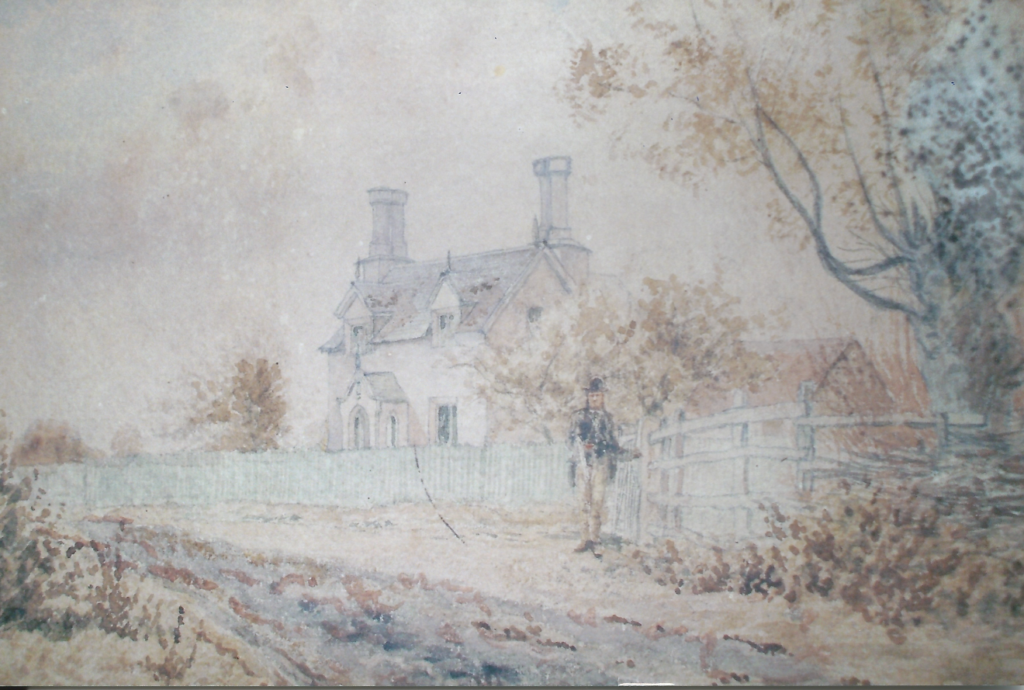
At the time of writing this narrative the painting is in the possession of Patricia Lucy Williams who is a great granddaughter of the subject of the painting Henry Timpson (TE6) and a first cousin twice removed of the painter W H C Groome (GT1).
Maybe Henry was not happy with his employer and was actively looking to move on or perhaps simply just looking for better pay but he answered a newspaper advert for a gamekeeper’s position at Woodeaton in Oxfordshire. Henry travelled down for an interview and was accepted. The family was to move in early 1871.
Life for Ann and Henry at ◆ Woodeaton →