
Henry and Ann Timpson · Woodeaten · 1871-1873
Woodeaton
There was no railway so they made the long journey by coach from Kings Cliffe to Woodeaton arriving in January 1871 well before the busy season for a gamekeeper.
woodeaton · oxfordshire · circa 1890
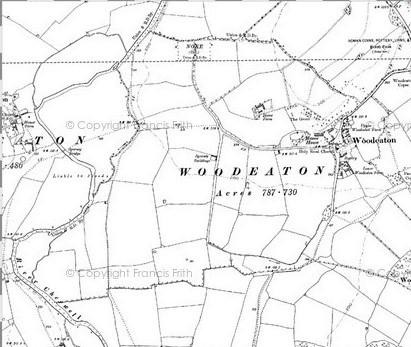
Small local map of the tiny village of Woodeaton.
≈ Ordnance Survey County Series · The Francis Frith Collection · 1898
See the journey from Kings Cliffe to Woodeaton today
oxfordshire · england · today
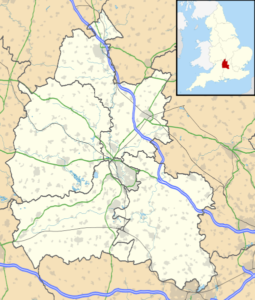
Map showing Oxfordshire, and the inset is England showing Oxfordshire within England. Northamptonshire is immediately north of Oxfordshire.
Woodeaton Manor
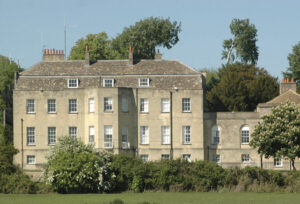
In 1774 John Nourse, the last of the male line, died and left the manor to his daughter Elizabeth Weyland, wife of John Weyland.
In 1775 Weyland had the old manor house demolished and the present Woodeaton Manor built. The new house has a modest exterior but in 1791 the architect Sir John Soane enhanced its main rooms with marble chimneypieces, added an Ionic porch of Coade stone, a service wing and an ornate main hall.
Henry’s new employer was John Weyland, eldest son of the above, who had married Lady Catherine de Burgh, daughter of the Marquess of Clanricarde.
1871 Census
The first time the family is recorded here is in the 1871 Census taken on 2 April 1871. Henry’s age is given as 38 and Ann 30.
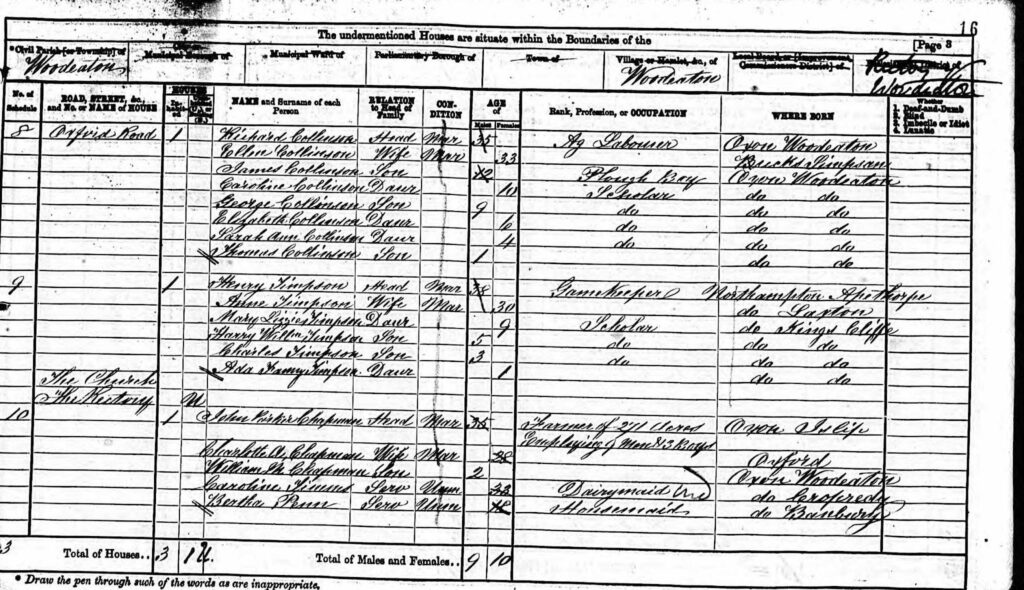
1871 census · woodeaton
Henry Timpson · Head · 38 · Gamekeeper
Ann Timpson · Wife · 30
Mary Lizzie Timpson · Daur · 9 · Scholar
Harry William Timpson · Son · 5 · Scholar
Charles Timpson · Son · 3 · Scholar
Ada Fanny Timpson · Daur · 1
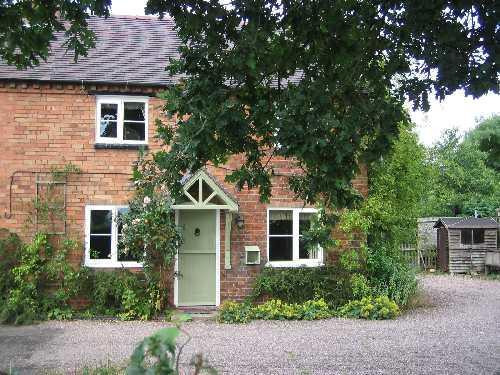
Henry and Ann are living at Cottage No.8, Oxford Road with their four children. The three eldest children are scholars including 3 year old Charles which is an unusually young age. The 1870 Education Act was now in place making schooling compulsory for five to thirteen year olds. Henry is, of course, a Gamekeeper.
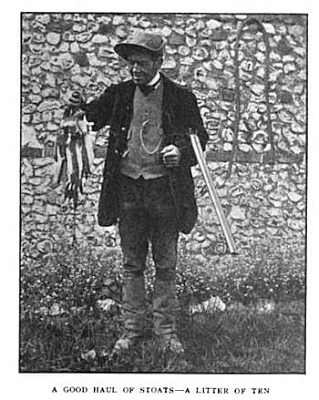
A description follows of the pay and living conditions of a Gamekeeper;
The actual wages of a first-class gamekeeper may be no more than a pound a week. A system has sprung up by which he receives, in addition to wages, many recompenses in kind, while his pay is fortified by the tips of the sportsman to whom he ministers.
Anon
With a liberal employer he may be well off, and all manner of good things may come his way; but with a mean employer the perquisites of his position may be few and far between.
At best he may live in a comfortable cottage, rent free.
His coal is supplied to him without cost and wood from the estate. Milk is drawn freely from the farm—or he may have free pasturage for a cow of his own. A new suit of clothes is presented to him each year. He may keep pigs for his own use, usually at his own expense, but this is a small item, and even here he may be helped out by a surplus of pig-food from the kitchen of the house or from the farms.
He has a fair chance to make money by dog-breeding and exhibiting. Then there is vermin and rabbit money which he earns as extra pay, and useful sums may flow into his pocket from the hunt fund.
So if John Weyland was generous it is easy to see how the family may have lived reasonably well and still been able to save money.
Ann’s and Henry’s Children Born at Woodeaton
George Herbert Timpson (TW6)
Their sixth child was born on 29 July 1871 at Woodeaton and registered in civil registration records by his mother on 24 January 1872. (This is a long time gap but as the village was very small there was probably nowhere close to register the child.) Henry’s occupation is given as Gamekeeper.
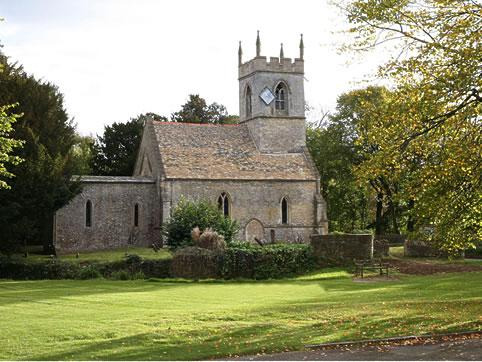
George Herbert was baptised at Holy Rood Church, Woodeaton on 19 November 1871 and parish registers have his baptism recorded as George Herbert Timson. Henry’s occupation is given as Gamekeeper.
(NB the Oxfordshire Family History Society has sole control over all historical parish records and no one can directly access them. Any genealogist has to pay them for information extracted and my own experience was a general indifference.)
Frank Timpson (TW7)
Their seventh child was born on 16 June 1873 at Woodeaton and was registered in civil registration records by his father on 25 July 1873. Henry’s occupation is given as Gamekeeper.
The Oxfordshire researcher did not offer a baptism record.
Sadly Frank passed away on 3 July 1873 at Woodeaton aged 2 weeks. His name was spelled correctly in the civil records. Henry’s occupation was given as Gamekeeper.
Frank’s burial took place at Holy Rood Church, Woodeaton 6 July 1873.
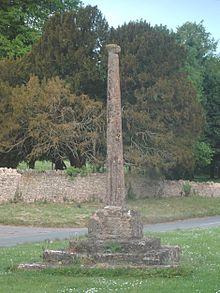
Ann Timpson looks for work
The article photographed below proves that Ann had worked at The Wheel Inn in Kings Cliffe. It is unlikely that she took up a position bearing in mind their next shift.

OXFORD JOURNAL · 14 & 21 February 1874
Ann Timpson advertised for work in February 1874
In the meantime Henry was actively looking for employment back near where they came from. He read of a Gamekeepers position at Glapthorn back in Northamptonshire. He applied and after an interview was accepted. They were to move again as soon as possible.
Read on to learn life for Henry and Ann at ◆ Glapthorne →