The Clipper Route
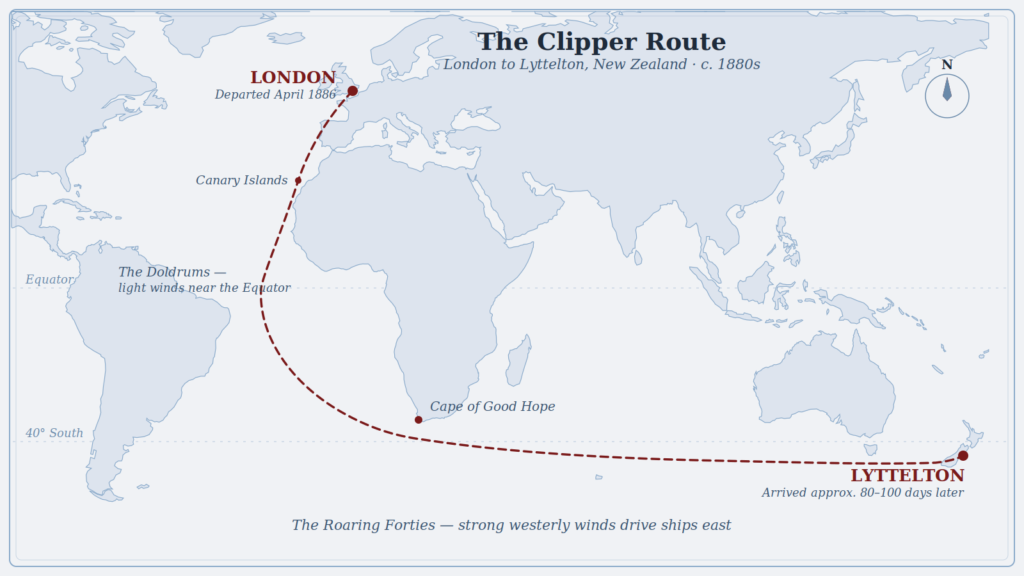
The Timpson family’s journey to New Zealand followed the famous “Clipper Route”. On the Timpson’s passage the Langstone took 96 days to reach Lyttelton in New Zealand.
The Ship
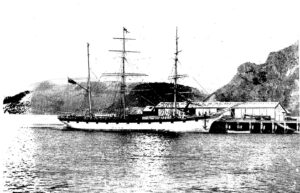
The Langstone was a three-masted iron sailing ship of around 766 tons, built in 1869 by William Pile & Co of Sunderland, one of the great shipbuilding yards of north-east England. She sailed for the Shaw, Savill & Company line, which carried thousands of emigrants and tonnes of cargo between Britain and New Zealand in the late nineteenth century. By the time of her April 1886 voyage she was a seasoned vessel of seventeen years, a regular on the New Zealand run.
Iron ships like the Langstone were the workhorses of the emigrant trade. These were stronger and roomier than the older wooden vessels, though still entirely dependent on the wind. A voyage to New Zealand meant roughly three months at sea, sailing day and night, in fair weather and foul.
The Route
By the 1880s the Clipper Route was the standard passage for sailing ships travelling between Britain and Australasia. Outbound vessels ran south through the Atlantic, then turned east below the Cape of Good Hope to pick up the Roaring Forties — the powerful westerly winds of the Southern Ocean — which carried them swiftly toward Australia and New Zealand.
The return leg continued eastward, rounding Cape Horn before heading north up the Atlantic, so a complete voyage effectively circled the globe. It was fast but punishing: ships endured freezing gales, mountainous seas, and the constant risk of ice the further south a captain dared to sail in search of stronger winds.
A passage from England to New Zealand typically took around 90 to 110 days, and by this era the route was already under pressure from steamships and the Suez Canal, though sail remained competitive for emigrants and bulk cargo into the 1890s.
Clipper Route Sections
Down the Atlantic
South from London, past the Bay of Biscay and the Canary Islands, picking up the north-east trade winds
The Doldrums
the frustrating band of light, fickle winds near the Equator, where a ship could drift for days barely moving
The South Atlantic
Swinging south-west towards the coast of Brazil to catch the south-east trade winds, then curving back east
Around the Cape of Good Hope
Passing south of Africa and dropping deep into the Southern Ocean
The Roaring Forties
The powerful westerly winds between 40 and 50 degrees south, which drove ships east at tremendous speed through enormous seas, with albatrosses overhead and the ever-present risk of icebergs
Landfall, New Zealand
Turning north at last towards the South Island and the entrance to Lyttelton Harbour.
A Voyage Without Ports
Remarkably, ships like the Langstone made this entire journey of some 14,000 miles without calling at a single port. There was no stopping for supplies. Everything needed for a hundred days at sea, for every passenger and crew member, was loaded in London before departure.
Ann’s diary makes no mention of going ashore anywhere on the voyage, and this is exactly right: from the day the English coast slipped out of sight to the day New Zealand rose on the horizon, the passengers saw nothing but ocean. Other sails on the horizon, passing whales, and seabirds were events worth recording.
Arrival at Lyttelton
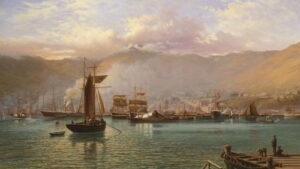
The voyage ended at Lyttelton, the port of Canterbury, set in a deep volcanic harbour on Banks Peninsula. After the ship anchored and cleared its inspections, passengers finally stepped onto New Zealand soil. For most, the first land they had touched in three months.
From Lyttelton, the new arrivals took the train to Christchurch through the Moorhouse rail tunnel, bored through the volcanic rock of the Port Hills and opened in 1867. At the time one of the engineering wonders of the colony. After more than three months and half the world travelled, the final leg of the Timpson family’s journey to their new home took barely twenty minutes.